
What is an invoice?
An invoice is a document you send to a client asking to be paid for work you have done or goods you have supplied. It records what was sold, for how much and when payment is due. For your client it is proof of the purchase; for you it is a record of income. If you are registered for VAT, GST or sales tax, the invoice is also a tax document, and the law in your country sets out what it must show.
What to include on an invoice
Every invoice, in every country, should have these details:
- The word “Invoice” (or “Tax invoice” if you are registered for VAT or GST and your country requires it).
- Your business details: name, address, email or phone, and your tax number if you have one.
- Your client’s details: name or company name and address, plus their tax number for business-to-business invoices where required.
- A unique invoice number that follows on from your last one.
- The invoice date, and the date of supply if it is different.
- The due date and payment terms.
- A list of what you are charging for: a clear description, quantity, unit price and line total for each item.
- Tax: the rate and amount for each type of tax, if you charge any.
- The total amount due and the currency.
- How to pay: bank details, UPI ID, payment link or other accepted methods.
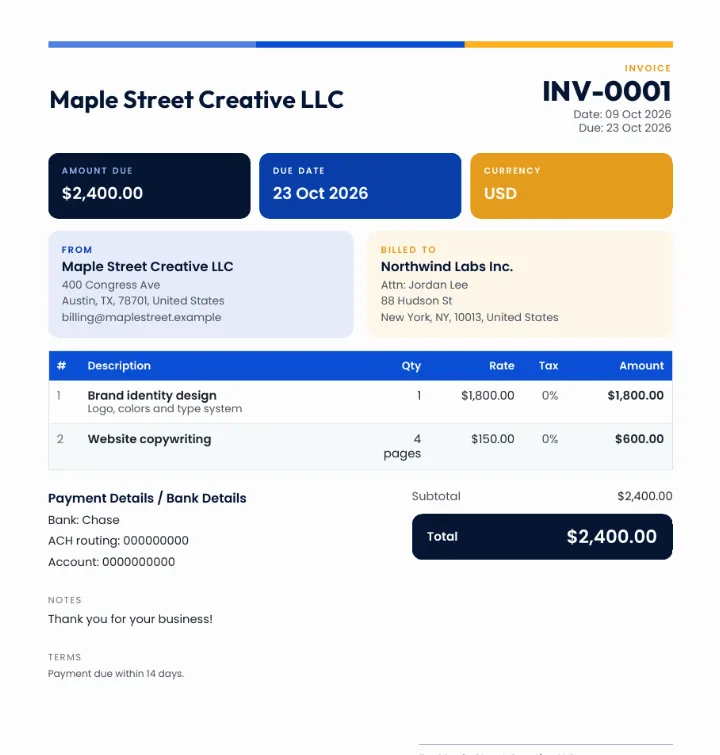
How to write an invoice in 7 steps
1. Add your business details and logo
Put your business name, address and contact details at the top. A logo makes the invoice instantly recognisable and looks professional. If you are registered for tax, add your tax number (for example your GSTIN, VAT number, TRN or ABN).
2. Add your client’s details
Use the client’s legal or company name and full address. For business clients, add a contact person so the invoice reaches the right desk, and their tax number if your country requires it on business invoices.
3. Give it a number and dates
Use a simple, ongoing sequence such as INV-0001, INV-0002, and never reuse a number. Add the invoice date and, if the work was delivered on a different day, the date of supply.
4. List the work or products
Write one line per item with a description your client will recognise, the quantity, the unit (hours, days, pieces) and the price. Specific descriptions such as “Website redesign: 12 pages, responsive layout” get approved faster than “Services”.
5. Add tax and discounts
Show any discount, then the tax rate and tax amount. If you bill clients in other countries, the tax often changes: exports may be zero-rated, and some business-to-business sales use a reverse charge. See the country notes below.
6. Set the payment terms and due date
State the due date clearly (“Due 23 October 2026”) and how to pay. Including several payment options, such as bank transfer and UPI or a card payment link, removes reasons to delay.
7. Send it and keep a copy
Send the invoice as a PDF attachment or a link, with a short, polite message. Keep a copy for your records, and check whether it has been opened and paid.
How to number invoices
Tax authorities expect invoice numbers to be unique and sequential, so you can show that no invoice is missing. A good format is a short prefix and a running number: INV-0001, INV-0002. Some businesses add the year (2026-001). If you make a mistake, do not delete the invoice; mark it as void or issue a credit note, so the number sequence has no gaps.
Payment terms that get you paid faster
- Use a date, not just “Net 30”. “Due 23 October 2026” leaves no room for doubt.
- Keep terms short where you can: 7 or 14 days for small jobs.
- Make paying easy: show bank details, a UPI QR code for Indian clients or a card payment link.
- Ask for a deposit on large projects before you start.
- Follow up politely on the due date, then again a week later.
Tax and invoice rules by country
If you are registered for tax, your invoices must show certain details. Below is a summary for seven common countries.
| Country | What a tax invoice must show |
|---|---|
| United States | No federal invoice law and no federal sales tax. Add state and local sales tax only where you are required to collect it. |
| United Kingdom | VAT invoices show your VAT number, a unique number, the issue date and time of supply, the customer’s name and address, a description and quantity, prices excluding VAT, the VAT rate and the total VAT in sterling. Retailers can use a simplified invoice for sales up to £250. |
| UAE | “Tax Invoice”, your name, address and TRN, the buyer’s name, address and TRN if registered, the invoice number and dates, line items, the VAT rate and amount (VAT is 5%), with VAT also shown in AED. |
| Singapore | GST-registered businesses issue a tax invoice showing the GST registration number, the customer’s name and address, the amount before GST, the GST rate (9%) and the total. A simplified tax invoice is allowed when the total is S$1,000 or less. |
| Australia | A tax invoice is labelled as one and shows your identity and ABN, the date, a description, quantity and price, and the GST amount (GST is 10%). For sales of A$1,000 or more it must also show the buyer’s identity or ABN. |
| Canada | The information required grows with the amount: from $100 add your GST/HST registration number and the tax charged; from $500 add the buyer’s name, the payment terms and a description of each item. |
| India | “Tax Invoice”, your GSTIN and the recipient’s GSTIN if registered, a consecutive number, HSN/SAC codes, the place of supply, the taxable value, CGST + SGST for sales in your state or IGST for other states, and the total. Exports show the destination country and the LUT or tax-paid endorsement. E-invoicing (IRN) applies above ₹5 crore turnover. |
This is a general summary, last reviewed in October 2026, not tax advice. Rules change and have exceptions, so check with your tax authority or accountant for your situation.
Common invoice mistakes
- Missing or repeated invoice numbers.
- Vague descriptions that the client’s accounts team cannot match to the work.
- The wrong tax: charging local tax on an export, or missing a reverse-charge note.
- No due date, or no clear way to pay.
- Sending to the wrong person: address it to the contact who approves payment.
- Editing an invoice after sending it instead of issuing a credit note.